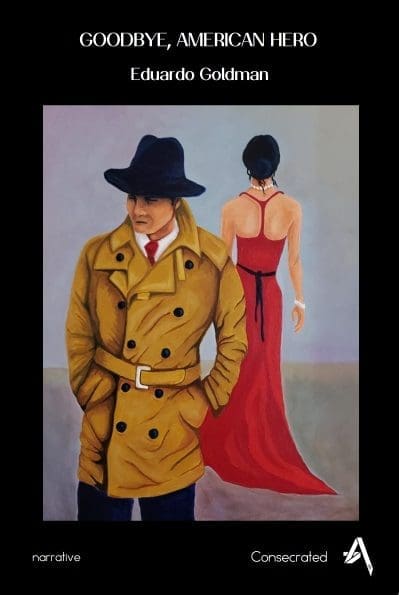

Fragmento gratis del libro Goodbye, American Hero (Edición en englés), de Eduardo Goldman
New York, 1981
I let the phone ring at least three times before I picked it up. From the other end came the thick voice of someone in a hurry.
“John Rossi?” the voice asked.
“Yes, who’s speaking?”
“Are you John Rossi, the private detective?” the guy persisted. He came across with a slightly foreign accent that reminded me of the villains in a lot of Hollywood films.
I repeated I was. Only then did the voice say he had a job for me and he’d be waiting to discuss it on Pier 5 at nine o’clock that night. It sounded too melodramatic. I thought to ask him up to my office for a drink instead, but at the same time I was afraid my potential client might not take to the idea, and I could not take the risk of his hanging up on me. I was short of work and even shorter of money. In fact, up until that day I’d only landed a handful of cases–mostly domestic affairs, small jobs, things like tailing a wayward schoolgirl or looking for a dachshund in Central Park. But now this mysterious voice seemed to be offering me something really big. Big and with a smell of money. So I took it on.
“What’s your name?” I asked.
“That doesn’t matter.”
“Fine but let me know how I’ll recognize you.”
An unpleasant sound came over the line that made me think of saliva, as if the guy was chewing or sucking on something.
“Don’t worry,” he said, “at that time of night we’ll be the only ones on the pier.”
He hung up.
I congratulated myself for having invested my last few bucks to put my name in bigger letters in the Yellow Pages. The move was obviously paying off. Still, the phone didn`t jingle again the rest of the afternoon, so I entertained myself with the Times crossword until the dot of eight. Then I locked up the office and dropped in at Tony’s to wolf down a piping hot cheese and tomato pizza. Not dawdling, I set off for Pier 5.
It’s my habit to arrive a few minutes early for appointments. I cut the motor of my old Ford and shoved my hands deep in my overcoat pockets. The pier was deserted–that’s the impression I had, anyway. I couldn’t be sure. The one streetlamp was not giving much light. Besides, in the thick fog there wasn’t a lot to see beyond the hood of my car. A tyrannosaurus could have been devouring one of the loading cranes and I would never have known.
All at once, the sound of an approaching car made me turn around. My back window lit up, got brighter and brighter, and then went dark. A black Cadillac crept slowly alongside. Only then did I notice I was a bit jumpy. Instinctively, I searched my memory. Was somebody out there after me? The answer was no. I had no enemies other than my landlady and collecting back rent this way was not her style.
After a minute, the Caddy’s door opened. A chauffeur in gray livery got out wearing a petulant look and motioned me to lower my window. I did.
“Mr. Steinberg’s waiting,” he said with exaggerated politeness, as if being polite was the last thing on earth he knew anything about.
He was average height, had a stocky build, a broad jaw, and a veiled Flatbush accent–obviously the type you’d hire as a chauffeur and bodyguard. He stared at me with a certain disapproval, but I couldn’t figure out why.
I got out of the car, and the chauffeur opened the rear door of the Caddy. I hesitated a moment or two, just enough to take a good look inside. There wasn’t a lot to see in the shadows, but I did catch a glimpse of a solidly fat man. Mr. Steinberg filled the seat, immoveable, deadpan. The intrigue and tension made me forget how cold the night was. Out on the river some tug let loose a mournful tooting.
“Get in … please,” the chauffeur said, unable to hide his annoyance. When I did, he slammed the door hard.
I was alone with the owner of the mysterious voice, and he did nothing to put me at ease. Hands crossed over his swollen belly, the guy kept staring at some indefinite spot straight ahead of him, obviously doing his best to ignore the fact that I was in the car. He didn’t bother to say hello or anything else. In fact, all he did was make a kind of clicking sound with his tongue, which he kept up unpleasantly. I sat rigid, as far away as I could. Then I made out the shape of an unlit cigar in his mouth. It was giving off a characteristic acrid smell, and the guy kept sucking on it obsessively.
“John Rossi?” he said after a while, his voice hoarser than it was on the phone.
I grunted.
“I’m Steinberg,” he immediately added. “Isaac Steinberg of the International Jewish Council.” And without giving me time to figure out what the hell the International Jewish Council wanted with me, he went on. “I’ll come straight to the point, Rossi. You’re going to find someone in Paraguay.”
It embarrasses me to admit I hadn’t the slightest idea where Paraguay was. Steinberg must have known that by my silence. He quickly said he was talking about a small South American country stuck between Brazil and Argentina.
“The man’s name is Ricardo López,” said Steinberg, “and he has decided to help us with information about the activities of Nazi fugitives in that country. You will find him and give him protection while you bring him back to New York.”
It seemed strange that the International Jewish Council was hiring the services of a private eye. An organization like theirs, I imagined, had any number of men experienced in that line of work.
“Why don’t you send one of your own agents?” I asked.
Steinberg sighed and sucked on his cigar a good four times before answering.
“Because they’re all well known to the Paraguayan authorities, and half the country’s customs officials are in the pay of the Nazis. But a simple American tourist will raise no suspicions. Besides, none of my available agents speak Spanish as well as you do.”
So, Steinberg had taken the trouble to look into my family background, checking out my Puerto Rican mother and Italian father with the painstaking devotion of someone studying a bloodhound’s pedigree. It made my skin crawl.
“Let me tell you, Mr. Steinberg, my fee–”
“There are five thousand dollars for you in this,” he cut in. “Half in advance.” And he slid an envelope out of his overcoat pocket.
I held my breath so as not to show my surprise, but somehow, I knew Steinberg had noticed.
He asked me about my passport, and I told him it was up to date. I got one just the year before in a frustrated attempt to see Europe, but I didn’t think this detail would interest Steinberg. He handed me what he said was a plane ticket and told me to get myself a visa at the Paraguayan consulate. He’d taken care of the rest. My flight was leaving for Asunción the next night, and I’d been booked into a room at the Hotel Guaraní, right in the middle of the Paraguayan capital. There, a Mr. Müller, a German who’d been living in Paraguay for years and who was under no suspicion on the part of the authorities, would look me up. Müller would lead me to López, and the next day I’d leave the country with the latter on a plane to New York, where Steinberg would be waiting at the airport. It all sounded easy. Easy and productive. Still, I couldn’t help a growing feeling of antipathy to Steinberg. That fat cigar chomper had turned into a chess computer before my very eyes. A computer with its whole game programmed–and in that game I was just a wooden pawn.
Steinberg held up a walkingstick and shoving it within inches of my nose gave the window on my side two dry taps. The chauffeur, who was leaning against my car, dropped his cigarette and came to open the door.
Before I got out, I was again treated to Steinberg’s hoarse voice. “Listen, Rossi,” he said by way of farewell, “your job is simple but important. I need López in New York, and the sooner the better.”